

How Do You Keep Indoor Plants Alive in a Restaurant?
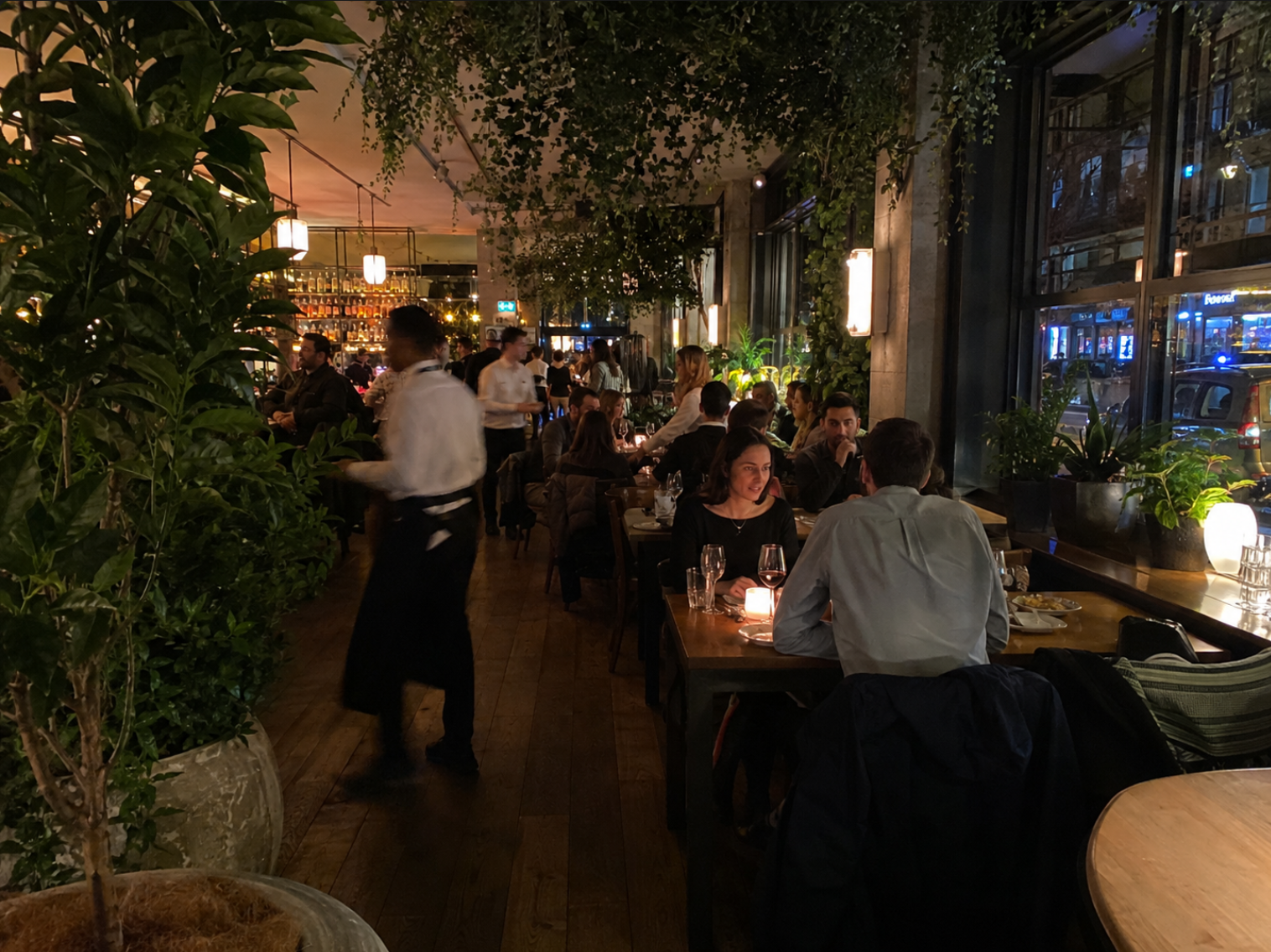
At half past eleven, the restaurant looks ideal for plants.
The tables are aligned. The chairs are tucked in. Daylight reaches further into the room than it will once the blinds are adjusted, the lights are dimmed and forty people sit between the windows and the back wall.
By eight, it is another environment. Chairs have moved. A planter has been pulled aside to make room for a larger table. The front door has opened two hundred times. Heat has travelled out from the kitchen, and somebody has put a coat over the plant near the banquette.
The following morning, the room becomes calm again. The plants are expected to behave as though nothing happened.
Restaurant plants do not live in the interior shown in the design photographs. They live through service. Keeping them healthy starts with understanding that working room, then placing planting where it can be both noticed and supported.
What makes restaurants difficult environments for plants?
A newly installed plant arrives with reserves built up under nursery conditions. It may look perfectly content for several weeks while adapting to a restaurant that gives it less light, less stable temperatures and rather more physical contact than it previously experienced.
The decline often appears later. Growth becomes thin. Lower leaves yellow. The plant leans towards the nearest window. Somebody notices the soil is damp and adds more water because yellow leaves look like thirst. The roots now have less oxygen as well as less light.
By the time the plant looks obviously unhappy, several small problems may have been accumulating for months. Replacing it with the same thing in the same position restarts the sequence without changing its conclusion.
How much usable light reaches the plants?
Restaurants are designed for human vision and atmosphere. Our eyes adapt quickly to a dim room, and decorative lighting makes tables, surfaces and faces legible. A plant cannot use atmosphere for photosynthesis.
The useful question is how much suitable light reaches the leaves, for how many hours, after the restaurant has been arranged for service.
A plant near a window may receive good morning light, then spend the afternoon behind a blind lowered to prevent glare. A specimen beneath a beautiful pendant may receive almost no useful growing light. The table is illuminated. The foliage is merely visible.
Plants described as tolerant of low light still need light. In poor conditions, growth slows and water use falls. Dense, handsome specimens gradually become thinner versions of themselves. Adding more water often makes matters worse because the growing medium is already drying slowly.
The room should therefore be assessed under its normal trading conditions, rather than on a bright morning before opening.
What changes during service?
Tables join together. Chairs are pulled back. Waiting staff find the shortest route between the pass and the floor. Bags, coats and highchairs occupy spaces that appeared empty on plan.
Planting that ignores these movements becomes something the team has to manage. A floor-standing display beside flexible tables may be shifted several times a week and rarely returns to precisely the same position. Leaves extending into a route are brushed by clothing and trays. Foliage beside a banquette becomes an accidental backrest.
Temperature changes are less visible. A plant beside the entrance receives a cold draught whenever the door opens in winter. Another near a radiator or warm-air outlet dries much faster than the rest of the collection. A display close to the kitchen may experience heat and dry air, while air conditioning produces a steady current elsewhere.
A healthy plant can tolerate some variation when its other needs are met. A specimen already struggling for light has far less resilience when it is also repeatedly chilled, dried or moved.
Cleaning introduces another layer. Planters are shifted to clean floors, leaves can be caught by equipment and sprays may reach foliage accidentally. Grease and dust also settle on leaves, particularly near open kitchens and busy London streets. The layer may be subtle, but it dulls the display and reduces the leaf surface available to use light.
None of this means restaurants are unsuitable for real plants. It means the empty room is the wrong version of the restaurant to design for.
How should planting be designed for a working restaurant?
Begin with the restaurant in motion.
Watch how guests enter, where queues form, which tables combine and how staff move from the pass to the floor. Notice where coats collect and which corners are repeatedly borrowed for highchairs, wine coolers or extra furniture.
Then consider the room as a growing environment. Assess the light after blinds and service lighting are in their normal positions. Identify draughts, heat sources and air-conditioning outlets. Establish how every display will be reached without climbing over a table of guests.
The strongest locations satisfy both versions of the brief. They improve the experience of the restaurant and provide conditions in which a living plant can remain healthy.
Where can plants live without obstructing service?
Entrances, windows, fixed banquettes, dividers and generous corners can all work, but the exact position matters more than the category.
A planter near the entrance can strengthen the view from the street without sitting in the door’s cold air current. Planting beside a fixed banquette can create intimacy without entering the space needed to pull out a chair. A group between dining areas can give structure to the room while keeping the main service route clear.
Restaurants contain a great deal of visual information. Tiny plants can vanish among glassware, menus, bottles and lighting. They also create many separate objects to move, inspect and water. A few substantial arrangements often produce more presence and fewer maintenance points than small pots distributed across every available shelf and table.
Scale should follow the room, but it should also follow the way people use it. A broad leaf that looks wonderfully dramatic in an empty corner may become irritating when it touches the shoulder of the person seated beside it. A trailing plant above a service station needs enough clearance to remain decorative rather than operational.
The best position is not simply the one with an empty patch of floor. It is the one that remains available when the restaurant is full.
When are grow lights worth using?
Grow lights are useful where the position matters more than the available daylight allows. They can support an important internal display, planted shelving or a feature that would otherwise be restricted to the brightest parts of the restaurant.
They do not need to turn dinner purple or make the room feel like an agricultural experiment. Suitable fittings can be discreet and coordinated with the interior lighting. What matters is the useful output reaching the foliage, the distance from the plant and a reliable daily schedule.
A decorative lamp aimed vaguely towards a leaf is not automatically a grow light. Timers also matter. Nobody should be responsible for remembering the plants while closing the restaurant after midnight.
Lighting cannot rescue every idea. Planting suspended somewhere that cannot be reached safely remains a maintenance problem with better illumination. A narrow shelf above a busy route may still be the wrong position, however favourable the light becomes.
Some locations cannot support living plants sensibly. Preserved moss can provide real natural texture without light or watering. In other places, an honest empty space is preferable to beginning a cycle of decline and replacement. Our article comparing real and artificial plants in commercial spaces explains why Greenarium works with living planting while remaining candid about unsuitable positions.
Good restaurant planting is edited. It concentrates the available budget and care in the places where plants can contribute to the room for years, rather than filling every gap for opening night.
Who should look after restaurant plants?
Restaurant plants attract helpful people.
A leaf droops, so somebody brings a glass of water. A manager waters on Monday, unaware that a member of the bar team did the same on Sunday night. The top of the growing medium looks dry, although the lower part of the planter is still wet.
The plant receives plenty of concern and very little consistency.
A fixed weekly quantity is not much better. Water use changes with light, temperature, growth and season. Two matching planters on opposite sides of the room may need different care.
Why is watering only part of the job?
Watering properly begins with checking the growing medium. It also means understanding how the display is constructed. Decorative planters need dependable liners or internal containers that allow appropriate drainage without risking the floor.
The rest of the visit is observation. Healthy restaurant planting needs:
Foliage cleaning, removing dust and grease so leaves can use the available light and the display still looks considered.
Pruning and turning, keeping growth balanced and stopping plants from entering routes or leaning heavily towards a window.
Feeding and growing-medium care, adjusted to the plant, light and season rather than applied automatically.
Early pest detection, before a small problem travels through closely grouped displays.
Checks around the planter, including liners, floors and nearby furniture.
A response to change, such as a moved planter, a closed blind or a new heating schedule.
A plant drying faster than its neighbours is information. So is one that remains wet long after the others. Replacing the plant without understanding that information is not a maintenance strategy.
Can restaurant staff maintain the plants themselves?
A small, straightforward collection can be cared for in-house. One person needs clear responsibility, useful guidance and a record of what has been done. The arrangement becomes unreliable when plant care belongs vaguely to everybody.
Professional maintenance becomes more valuable as displays grow larger, spread through several areas or become important to the design of the restaurant. A technician can adjust care with the seasons, identify problems early and recommend moving a plant when the position has proved unsuitable.
Our guide to whether professional plant maintenance is worth it looks more closely at the difference between routine watering and considered care.
The team running a restaurant is already thinking about covers, deliveries, staffing and service. Nobody is likely to remember that the planter near the window has been moved fifteen centimetres into a radiator’s warm air. Plant maintenance works when noticing details like that is somebody’s recognised job.
Real plants can work extremely well in restaurants. They soften hard finishes, create intimacy between tables, strengthen the arrival and bring life into a room made largely from manufactured surfaces.
Their success depends on designing for the restaurant people actually use. That may mean grow lighting in one important internal position. It may mean leaving an impossible shelf alone. It often means a few generous displays rather than greenery everywhere.
The best restaurant planting eventually stops calling attention to its own survival. It belongs to the room, copes with the evening and is ready to do it again tomorrow.
Frequently asked questions
Are indoor plants hygienic in a restaurant?
Well-maintained plants can be used successfully in dining areas when foliage, planters and surrounding surfaces are kept clean. They should remain clear of food preparation, service routes and positions where normal cleaning cannot happen safely.
Can ordinary restaurant lighting keep plants alive?
Decorative lighting is designed for people and does not necessarily provide the intensity or spectrum plants need. Where natural light is insufficient, properly specified grow lighting may be required.
How much does restaurant plant maintenance cost?
The cost depends on the number and complexity of displays, how widely they are spread, access and visit frequency. A compact collection may require a short regular visit, while planting across several dining areas needs more time for inspection, cleaning and care.