

Are Fake Plants Better Than Real Plants for Offices and Hospitality Spaces?
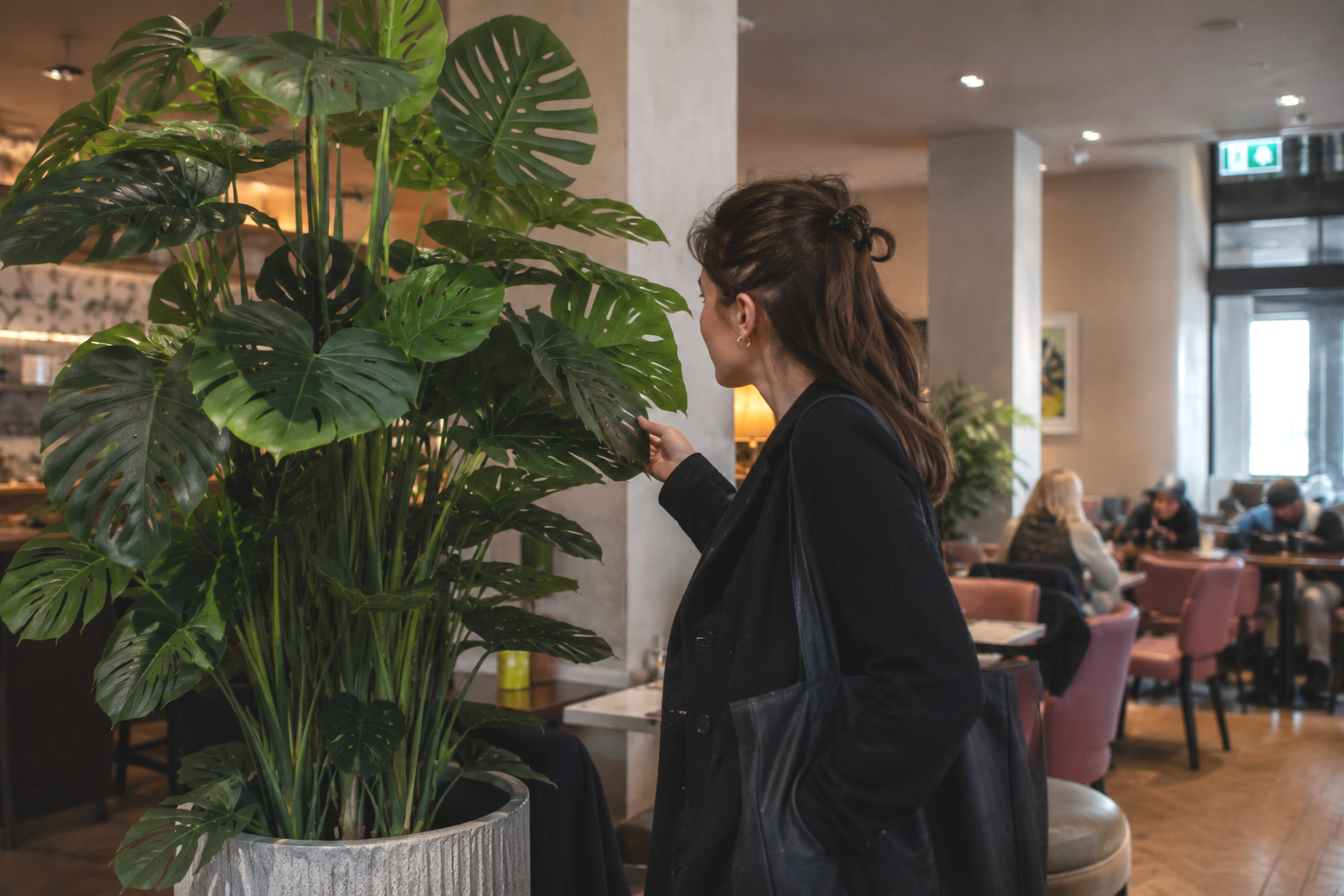
Fake plants promise no watering and no mess. But are they better than real plants for an office, hotel or restaurant? Here is the honest answer.
Artificial plants have become genuinely convincing.
Some are now so realistic that people reach out to touch them, just to confirm whether the thing is actually alive.
Many of them photograph beautifully. In the right interior, they can look excellent.
So it is easy to understand why a business would consider them. No watering. No maintenance. No dying leaves. No mysterious plant emergency the morning of an important booking or client meeting.
On paper, they can look like the simpler and cheaper option.
For most commercial spaces, though, real plants are the better choice.
Living greenery delivers the wellbeing and atmosphere that offices, hotels and restaurants are usually seeking in the first place. Research consistently associates real plants, rather than representations of them, with lower stress and a stronger sense of place.
Artificial plants can still be a sensible answer in a few specific situations, which we will come to honestly.
Here is how the two compare, beyond the marketing.
Do fake plants create the same feeling as real plants?
Visually, they sometimes come surprisingly close. Emotionally, the research suggests they do not.
Studies in environmental psychology and biophilic design consistently associate real natural elements with reduced stress, improved mood, better attention and greater wellbeing.
A well-made artificial plant can soften the look of a room. It does not appear to recreate the subtler sensory cues of living greenery.
One interesting strand of research concerns the biophilic response. This is the idea that humans are biologically inclined to respond well to living natural systems, because of a long evolutionary relationship with them.
That sounds slightly grand when the subject is a lobby fern. It also makes intuitive sense.
For most of human history, living environments were tied closely to safety, water, food and shelter. Our nervous systems developed in relationship with living ecosystems, not synthetic versions of them.
An artificial plant can imitate the visual language of nature. It cannot actually be nature.
People seem oddly good at sensing that difference, even when nobody says a word about it.
What does this mean for hotels, restaurants and cafés?
In hospitality, the feeling of a space is much of what a guest is paying for, and that is exactly where living plants tend to earn their place.
A hotel lobby, a restaurant or a café is in the business of atmosphere. Plants there are not only decoration. They are part of the first impression and part of the story the space is telling.
A scheme of genuinely thriving plants tends to read as cared-for. Guests rarely analyse why. They simply feel that the room has been looked after, which is usually how they end up feeling about the business too.
Living plants also bring things an artificial arrangement cannot. Subtle movement. Freshness. The quiet sense that the space is alive rather than staged.
In a setting where people linger over a meal or a coffee, that authenticity matters more, not less. Guests are present, unhurried and sensory. They notice.
Hospitality does bring real challenges, and it would be dishonest to skip them.
Moody restaurant lighting, high foot traffic and guests brushing past the planting all ask more of a living scheme. The honest answer is not artificial plants. It is the right plant selection for the conditions, and a maintenance routine that keeps everything looking its best.
That is usually a question of choosing well and caring properly, rather than giving up on living plants altogether.
And what about offices?
For an office, the case for real plants is mostly about the people who spend all day in it.
Exposure to real indoor plants has been associated with lower stress, improved concentration, better mood and higher workplace satisfaction.
Artificial plants, by contrast, tend to offer mainly a visual effect. That still has value. A softer-looking room usually feels more welcoming than a completely bare one.
The distinction is simply that looking like nature and biologically being nature are not the same thing.
A well-kept living scheme tends to feel calmer, more grounded and somehow more breathable.
A heavily artificial one can start to feel faintly uncanny once people have spent enough time with it. Not unpleasant exactly. Just subtly switched off.
Do fake plants really save money and hassle?
Sometimes, yes. This is where the comparison becomes more nuanced than it first appears.
If a business simply wants a touch of green colour, some visual softening, or planting in a genuinely inaccessible spot with no maintenance obligation, artificial plants can make practical sense.
Over the longer term, though, the assumption that fake is cheaper does not always hold.
Good artificial plants are often surprisingly expensive. This is especially true of larger commercial-grade pieces that avoid looking obviously plastic from a couple of metres away.
They also do not improve.
A healthy living plant tends to grow fuller and more characterful as it matures. An artificial plant begins and ends in exactly the same condition, quietly gathering dust until someone remembers it is there.
Real plants ask for ongoing care. Artificial plants ask for ongoing pretending.
Most people, given a little time in the room, can feel which is which.
When do fake plants actually make sense?
In a few genuine situations, they are the sensible answer, and it would be dishonest to pretend otherwise.
A windowless corridor, a sealed lightwell, a shelf nobody can safely reach, or a short-term fit-out for an event may not support living plants sensibly.
Forcing a real plant into a spot where it has no chance of surviving helps no one, least of all the plant.
In those cases, a business essentially has two honest options.
One is high-quality artificial or preserved planting, chosen with eyes open about what it is.
The other, which we tend to prefer, is preserved moss. This is real plant material, stabilised so that it needs no light or water while keeping a genuinely natural texture.
Greenarium does not supply artificial plants ourselves. But we would always rather a client understood the real trade-off than be sold a living scheme destined to struggle in a location that was never going to work.
So why does Greenarium only work with living plants?
Because our purpose is not really to add green objects to a room. It is to bring living nature into everyday spaces, which is a different thing altogether.
We think of plants as living organisms first and design elements second. That belief shapes every recommendation we make.
We happen to like the unpredictability of real plants. The seasonal change. The slow way a space evolves as things grow.
A living plant is part of the life of a room, not only part of its styling.
And yes, occasionally that means a plant becomes dramatic about its lighting and starts leaning determinedly towards the nearest window, as though staging a quiet protest.
We rather enjoy that too. Living things are not meant to behave like static props, which is roughly the whole point.
None of this makes artificial plants a poor choice for the few spaces that genuinely need them. It simply explains why living greenery is the only thing we work with.
So, are fake plants better than real plants?
For most offices, hotels and restaurants, no.
Real plants deliver the wellbeing, focus and atmosphere that research associates with living nature, and they tend to improve rather than merely endure.
Artificial plants offer mainly a visual effect. That is still worth something. It is not the same experience.
For a small number of genuinely difficult spots, artificial or preserved planting can be the honest, practical answer, and there is no shame in choosing it there.
In a working world increasingly full of screens, artificial light and synthetic surfaces, the difference between simulating nature and actually inviting it in feels more worthwhile than ever.
That distinction is really what a space is choosing between.
If you would like an honest view on which parts of your office, hotel or wellness space or restaurant or café could support thriving living plants, and which genuinely could not, we are always glad to take a look.
Frequently asked questions
Are fake plants better than real plants for offices? For most offices, real plants are the better choice, because living greenery delivers the wellbeing, focus and air-quality benefits that research associates with real nature, and it improves as it matures. Artificial plants provide mainly a visual effect and can suit a few difficult spots, but they do not recreate the psychological benefits of living plants.
Are real or fake plants better for hotels and restaurants? In hospitality, real plants usually win, because atmosphere and first impressions are central and a thriving living scheme reads as genuinely cared-for. Living plants add freshness and a sense of life that guests notice, especially when they linger. Artificial planting can suit very low-light or high-traffic corners, but the honest answer there is the right plant choice and good maintenance rather than fake greenery.
Do artificial plants have any wellbeing benefits? Their benefit is mainly aesthetic. A softer-looking room can feel more welcoming than a bare one. Research, however, associates the measurable wellbeing effects, such as lower stress and better concentration, with real living plants rather than artificial ones.
Are fake plants cheaper than real plants in the long run? Not always. High-quality commercial artificial plants can be expensive to buy, and unlike living plants they do not grow or improve over time. Real plants carry an ongoing maintenance cost but tend to become fuller and more valuable to the space as they mature.
When do artificial plants make sense? In genuinely difficult locations, such as windowless corridors, sealed lightwells, inaccessible shelves or short-term event spaces, where living plants cannot realistically survive. In many of those cases preserved moss, which is real plant material, is a natural-feeling alternative to fully artificial planting.
Does Greenarium supply fake plants? No. Greenarium works only with living plants, because we believe the value is in bringing real nature into a space. Where a spot genuinely cannot support living plants, we will say so honestly and suggest preserved moss rather than artificial planting.
Research sources
The physiological and psychological relaxing effects of viewing indoor plants:
Human responses to biophilic design in indoor environments:
Biophilic design and workplace wellbeing research review: