

Can Real Plants Work in a Windowless Hotel Corridor?
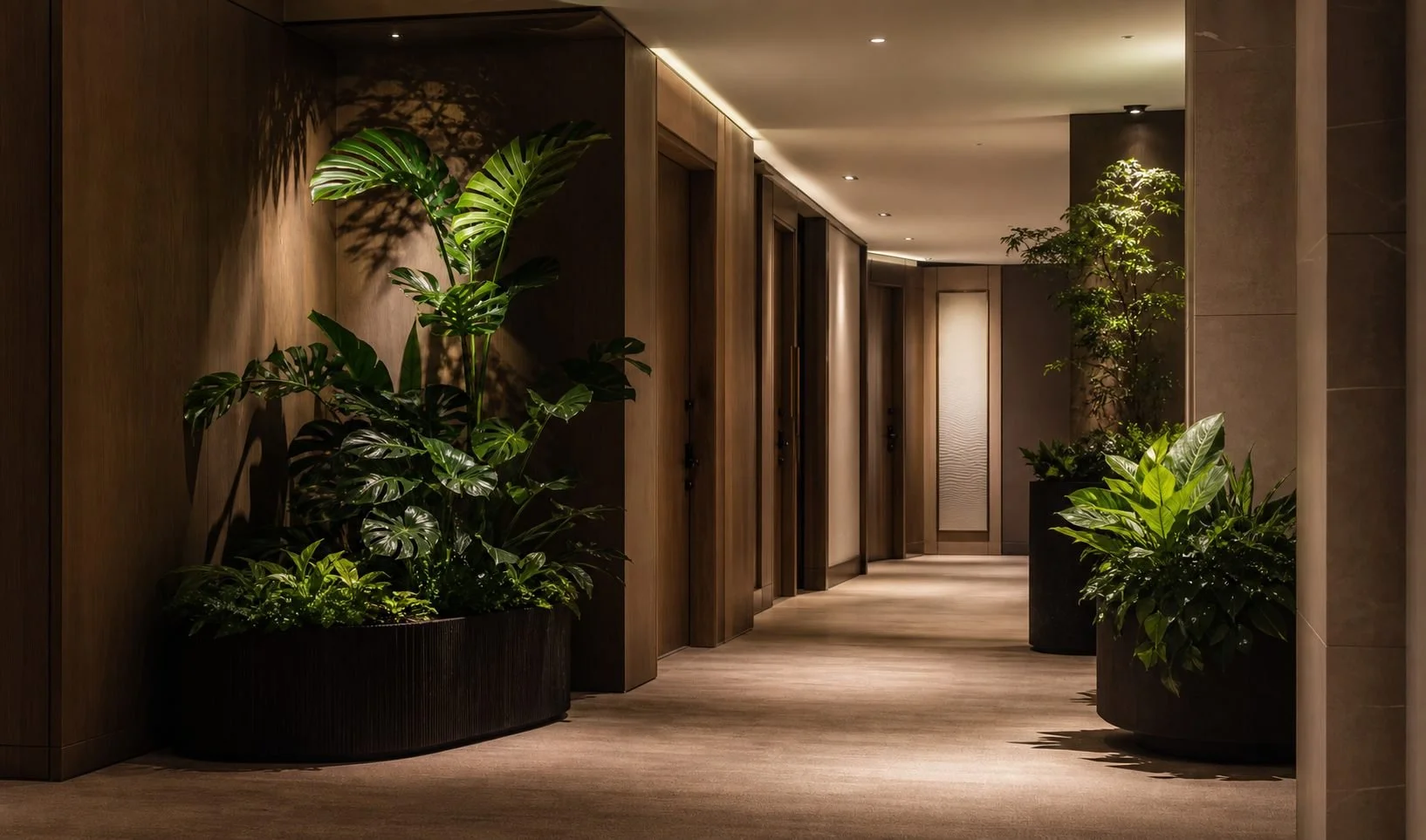
No plant lives without light. A plant described as tolerant of low light still needs light it can use.
That distinction gets lost easily in commercial interiors. A corridor may look bright enough to a guest because the floor is evenly illuminated and every door number is clear. That does not tell us how much useful light reaches the leaves, or for how long.
In a genuinely windowless corridor, a living scheme depends on artificial light doing the job that daylight would otherwise do. This is possible. The Royal Horticultural Society notes that plants from naturally lower-light habitats can be maintained under suitable artificial lighting.
Suitable is the important word.
The fixture, its distance from the foliage, the area it covers and the daily operating period all affect the result. A plant placed decoratively beneath a distant ceiling fitting may still receive very little useful light, however bright the carpet looks.
Will the hotel’s normal corridor lighting be enough?
Sometimes building lighting contributes. It should never be assumed to be sufficient without checking it.
Hotel corridor lighting is usually designed for people. It helps guests move safely, read signs and find locks without turning a bedroom floor into an airport runway. The priorities for a plant are different.
Light for planting needs to arrive at the leaves with enough intensity and coverage. Duration matters too. A corridor light that activates briefly when somebody walks past may be efficient for the hotel and rather unhelpful for the plant.
This is where the planting and lighting conversations need to meet. A discreet grow light can be integrated into a ceiling, shelf or joinery detail, but it has to be aimed and scheduled as horticultural equipment. Calling an ordinary lamp a grow light does not change what reaches the plant.
The best answer is usually decided before the final electrical layout. Retrofitting can still work, though the available positions and cable routes may narrow the design.
What should a grow-light scheme account for?
A useful scheme begins with the plant's needs and the reality of the corridor, then finds a fitting that can serve both without making the floor feel clinical.
The assessment should include:
Intensity at leaf level. Distance matters, so a powerful-looking fitting mounted far away may deliver less than expected where the plant actually sits.
Daily duration. Plants need a consistent light and dark pattern. Controls should not depend on somebody remembering a switch in a back office.
Coverage as the plant grows. A narrow beam that reaches a new plant may miss much of it once the foliage becomes fuller.
Colour and guest experience. The light must support the plant without turning the corridor into a propagation room.
Heat, access and servicing. A fitting has to be safe, maintainable and compatible with the building's operational and fire-safety requirements.
The exact specification is project work. It depends on the selected plants, mounting position, finishes and operating pattern, and should be agreed with the relevant lighting and building specialists.
What matters at article level is simpler: the grow light is part of the growing environment. It cannot be added as a decorative afterthought and expected to rescue any plant placed beneath it.
Which plants suit a windowless hotel corridor?
The useful choice is a design character first, followed by plants that can deliver it under the proposed lighting.
A generic list skips the most important information. The right answer changes with ceiling height, available depth, temperature, airflow, guest contact and the visual identity of the hotel. It also changes with the lighting system the building is willing to support.
Plants with comparatively lower light requirements may give the scheme more tolerance, but tolerance is not permission to ignore the environment. The aim is healthy, convincing growth, not a plant that declines slowly enough to survive the photography.
Scale deserves attention as well. Corridors rarely need a polite pot beside every bedroom door. Repetition can make the floor feel busier and creates more points for watering, cleaning and accidental contact.
A small number of generous planted moments often works harder:
at a lift lobby where guests pause;
at the end of a long sightline;
beside a seating recess with enough clear width;
at a junction that needs an identity.
This keeps escape routes and housekeeping movements clear while giving the greenery enough presence to feel deliberate.
How does hotel life change the design?
The corridor looks wonderfully calm during a site visit at eleven in the morning. The useful version is the one with luggage, linen cages, room-service trays and guests trying to remember whether 417 was left or right.
Planting has to work in that version too.
Clear width and escape routes come first. Leaves should not brush every suitcase or narrow a turning point. Pots need protection from trolleys, and any cable or lighting detail has to disappear into the building rather than create a new obstacle.
Housekeeping affects access in less obvious ways. A plant may be easy to reach when the corridor is empty and awkward once equipment occupies its usual position. Cleaning products, draughts from service doors and temperature changes near lifts can also create local conditions that differ along the same floor.
The corridor is therefore not one environment. It is a series of small ones connected by carpet.
That is why placement should follow an operational walk-through, not only a floor plan.
Will grow lights make the corridor look strange?
They should not. If the first thing a guest notices is horticultural equipment, the design has stopped one step too early.
Warm-white fittings can often be integrated with the architectural lighting language, provided they still deliver what the plants require. The beam can be focused on foliage, with controls handling the daily schedule out of sight.
There is a balance to hold. Hiding the fitting so completely that little useful light reaches the leaves defeats the purpose. Specifying an intrusive fitting purely for output can change the atmosphere of the floor.
The better solution is collaborative. Planting, interiors and lighting are resolved together, with mock-ups where the visual effect or coverage is uncertain. The result should feel like part of the hotel, not equipment borrowed from a greenhouse.
What maintenance does the planting need?
Grow lights solve the absence of daylight. They do not remove the need for care.
Plants in lower-light environments may grow and use water differently from those near a bright window. Watering should respond to the actual plant and growing medium, rather than a fixed assumption that every visit requires the same amount.
Maintenance also needs to check:
whether foliage is reaching or turning towards the light;
whether growth remains balanced beneath the beam;
whether the timer and fittings are operating correctly;
whether dust is reducing the effect of light on the leaves;
whether guest contact or trolley movement is damaging the display.
The people maintaining the scheme become part of the feedback loop. If a plant is telling us the position is not working, moving it or changing the lighting is usually more useful than waiting for decline and ordering a replacement.
That plant-first approach shapes Greenarium's hotel and wellness planting work. It is also visible in The Standard Hotel case study, where ongoing care included revitalising struggling plants rather than treating replacement as the maintenance plan.
What if suitable grow lighting cannot be installed?
Then living plants may not be the responsible choice for that corridor.
There can be good reasons. The electrical design may be fixed, the necessary position may conflict with life-safety requirements, or the hotel may not want the energy and maintenance commitment. A beautiful concept does not become kinder to a plant because it passed a design review.
Greenarium does not supply fake plants. Our reasons are explained more fully in our comparison of real and artificial planting.
Preserved moss can be an honest option in a position that cannot support life. Sometimes the stronger answer is to leave the corridor unplanted and concentrate living greenery where the building can sustain it properly.
Real planting is valuable because it is alive. Designing the conditions that keep it that way is part of the work.
So, can real plants work in a windowless hotel corridor?
Yes, when the corridor is designed to support them.
That means suitable grow lighting, selected plants with compatible needs, positions that work during hotel operations and maintenance that responds to what the plants are doing.
It does not mean finding a supposedly indestructible plant and asking it to manage without light.
The best corridor scheme may contain only two or three planted moments. If those plants are healthy, generous and properly lit, they will give the floor more life than a longer line of compromised pots.
Guests will probably never notice the grow lights. They will notice that the route to their room feels considered and cared for, which is exactly how it should work.
If you are planning planting for a hotel corridor in London, we are glad to assess what the space can genuinely support before the electrical and planting decisions drift apart.
Frequently asked questions
Can grow lights run while hotel guests are sleeping?
They can be scheduled around the hotel's operation, but plants still need an appropriate light and dark pattern. The timing should be agreed as part of the lighting design so it supports the plants without spilling unwanted light into bedrooms or disturbing guests.
Can hotel corridor plants be rotated into daylight instead?
Rotation can help in some managed collections, but it adds handling, storage and transport demands. For a permanent corridor scheme, providing stable conditions in the intended position is usually more reliable than repeatedly moving large plants through guest areas.
Do grow lights increase hotel energy use?
Yes, any additional lighting uses energy. The relevant question is how much light the selected scheme needs, how efficiently it can be delivered and how controls can limit operation to the required period. The answer belongs in the project assessment rather than a generic wattage promise.
Is preserved moss a real plant?
Preserved moss began as living plant material but has been treated so it no longer grows or needs light and water. It can retain a natural texture in positions that cannot support living plants, although it should not be described as a living planting scheme.