

When Does an Indoor Planting Scheme Need an Irrigation System?
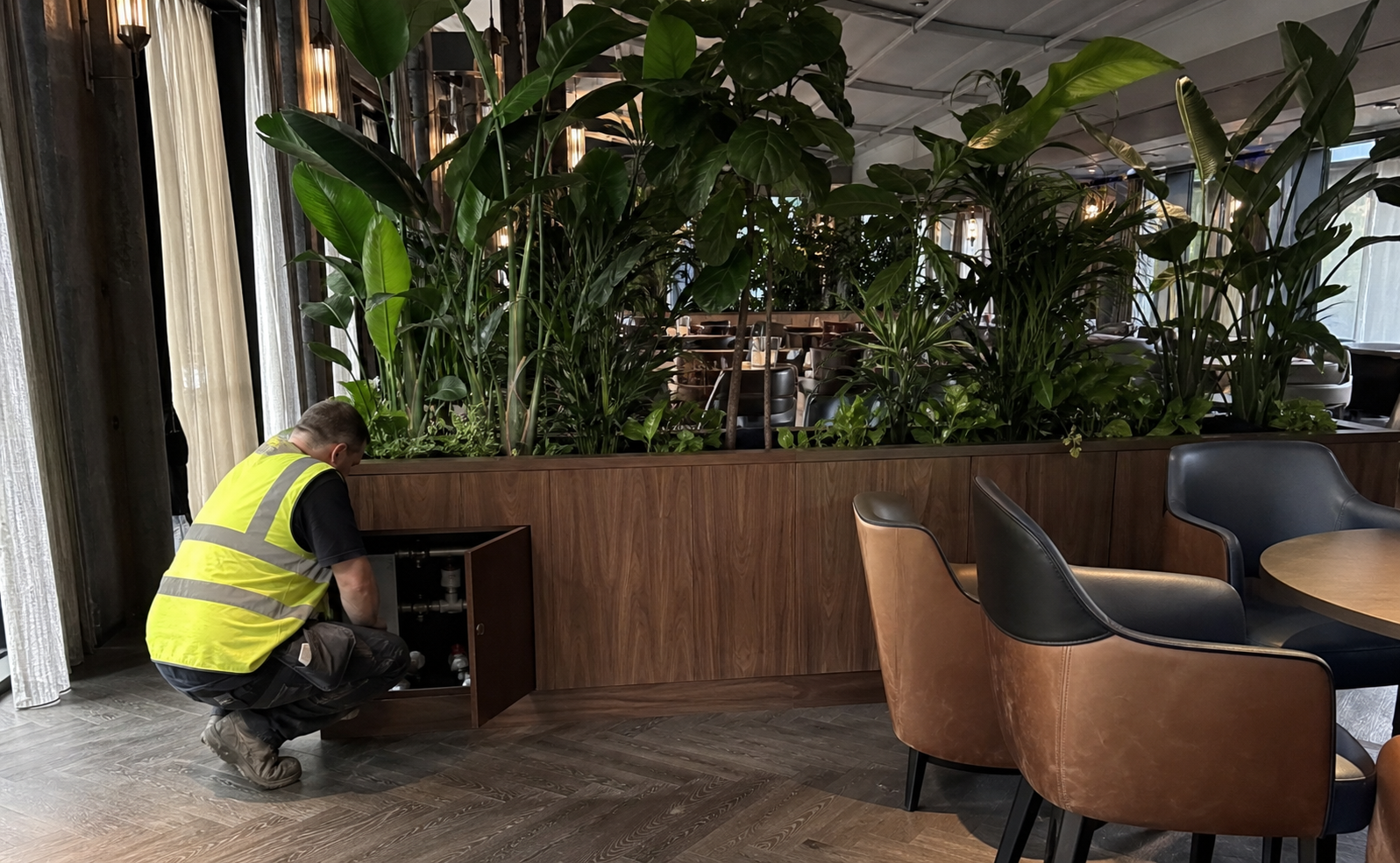
The planter running through the middle of the restaurant looks simple once it is finished.
Guests see a long line of foliage separating the tables. The joinery conceals the growing containers, the plants appear to rise directly from the furniture and there is no watering can parked beside the waiter station.
Behind that simplicity is a decision somebody had to make much earlier: how will water reach every plant once the restaurant is open?
For a few accessible displays, the answer may be straightforward. A plant technician checks each planter and waters according to what it needs. Extend the planting through fixed joinery, across several floors or above an area that cannot easily be closed, and the same approach starts to look less simple.
This is where irrigation enters the conversation. It can make a complex scheme more consistent and practical, but it also introduces reservoirs, pumps, pipework, controls and the possibility of leaks. Automatic watering is still a system that somebody must understand and maintain.
The useful question is therefore not whether irrigation is more professional than manual watering. It is whether the planting, building and operating team genuinely need it.
Can an indoor planting scheme be watered manually?
Manual watering works well when every display can be reached safely and the amount of work remains realistic.
Consider a café with two substantial plants near the entrance, a group beside a window and a planted shelf behind fixed seating. The displays are easy to inspect, a maintenance visit can happen before service and each plant can be watered according to its condition.
Adding irrigation would solve very little. It would introduce equipment into a scheme that is already manageable.
The same can be true in a hotel reception or a smaller office. Twelve generous planters arranged in sensible locations may take less time to maintain than forty small pots distributed across shelving, tables and meeting rooms. The number of plants matters, but their distribution matters just as much.
Manual watering also allows the technician to respond to what is happening in the room.
Two matching planters do not necessarily use water at the same rate. One may receive afternoon sun while the other sits closer to an air-conditioning outlet. A planter beside the entrance may behave differently in January than it does in July. Watering by inspection accommodates those differences.
A fixed amount delivered on a fixed schedule cannot always do that without adjustment.
The problem begins when manual watering is treated as somebody’s occasional task rather than part of a maintenance system. One member of staff waters on Monday, another sees a drooping leaf on Tuesday and adds a little more. By Friday, the top of the growing medium looks dry while water has collected below.
Helpful watering is still inconsistent watering.
A manually maintained scheme needs:
Clear responsibility. One person or professional team should know what has been checked and watered. Plant care cannot belong vaguely to everybody.
Safe access. The growing medium must be reachable without climbing across furniture, interrupting guests or placing equipment in a live circulation route.
Suitable internal containers. Decorative planters need liners and planting systems that manage water without putting floors, joinery or nearby furniture at risk.
Enough maintenance time. A scheme that technically can be watered by hand may still be impractical if reaching every display turns a normal visit into an expedition around the building.
Manual watering is not the basic option that clients graduate from when a project becomes more sophisticated. In an accessible, professionally maintained scheme, it can be the more flexible and dependable solution.
When does an irrigation system become worthwhile?
Irrigation becomes useful when the arrangement of the planting makes consistent manual watering difficult, disruptive or disproportionately time-consuming.
A long planter built into an office divider is a different proposition from a collection of movable floor-standing pots. So is a planted banquette that can only be reached by moving tables, or a hotel scheme distributed across reception, lounges, corridors and event spaces.
High-level and vertical planting make the distinction clearer. A living wall contains many plants within one connected system. Reaching each pocket with a watering can would be inefficient and unlikely to distribute water evenly. Irrigation becomes part of how the feature functions, rather than an optional convenience added afterwards.
The strongest cases tend to involve one or more of these conditions:
The planting is integrated. Long troughs, living walls and built-in planters are difficult to treat as separate individual displays.
Access is restricted. Watering would require moving furniture, entering guest areas at awkward times or repeatedly using access equipment.
The scheme is widely distributed. Displays across multiple floors or departments can consume significant maintenance time even when none is particularly complicated alone.
Uneven watering would have wider consequences. In a connected display, one dry section can weaken the visual effect of the whole installation.
The venue’s operating hours leave a narrow maintenance window. A restaurant preparing for lunch, a hotel receiving guests throughout the day and an office with continuously occupied communal areas offer different access problems.
Imagine two London hospitality projects.
The first is an independent restaurant with eight accessible planters concentrated around the entrance and dining room. A technician can inspect and water them before service without disturbing the team. Manual watering remains sensible.
The second is a hotel with integrated planting through the lobby, a planted screen beside the lounge and displays across several public floors. Some areas are continuously occupied and several troughs cannot be reached without moving furniture. Irrigation may reduce disruption and make water delivery more consistent, provided the building can support the system properly.
Neither decision is determined by a neat plant-number threshold.
A poorly planned irrigation system can be less reliable than considered manual care. A pump can fail. A pipe can become blocked. A reservoir can run empty. Different plants within the same zone may use water at different rates, particularly when light and temperature vary along the display.
Irrigation earns its place when it answers a known operational problem. Installing it simply because the scheme is expensive confuses complexity with quality.
What does an indoor irrigation system actually require?
The neatest irrigation systems begin as part of the fit-out conversation, not as equipment hidden inside finished joinery at the last moment.
The exact arrangement depends on the planting and building. Some systems connect to a permanent water supply. Others use a reservoir that must be refilled. Water may drain away, collect for disposal or circulate through a closed system.
Each choice changes what the design team needs to provide.
A system may involve:
Water storage or supply. A reservoir needs sufficient capacity and a practical way to refill it. A mains-fed system requires coordination with the relevant building services.
Pumps, valves and pipework. These must distribute water through the planting and remain accessible when inspection or replacement is required.
Drainage or water recovery. Excess water needs somewhere safe to go. The answer cannot be discovered after it has reached the finished floor.
Power and controls. Pumps, timers, monitoring equipment and alarms may require an electrical supply that should be coordinated before the surrounding finishes are complete.
Waterproofing and leak protection. Integrated planters sit beside materials somebody has spent considerable money specifying. The protection around the growing system deserves the same attention as its appearance.
Maintenance access. A concealed access panel is only useful if it can still be opened after the furniture, stonework and planting have been installed.
The system also needs to reflect the plants rather than merely the shape of the joinery. A long trough may cross areas with different light, heat and airflow. Treating the entire display as one identical watering zone may be convenient on a drawing and less convincing once the plants begin responding to the room.
This is why irrigation does not remove the need for plant maintenance.
It can deliver water, but it cannot decide that one section is remaining too wet. It will not notice a blocked emitter, clean the foliage, prune growth away from a route or identify the early signs of a pest problem. Somebody still needs to inspect the plants and the equipment, then adjust the system as conditions change.
Automation reduces repetition. It does not replace observation.
There is also a financial distinction worth making. Irrigation can reduce the time spent physically carrying water around a large scheme, but it brings an installation cost and an ongoing responsibility. For an accessible group of planters, that exchange may make little sense. For a substantial living wall or an integrated scheme across a busy hotel, the operational benefit can justify the additional infrastructure.
The decision belongs alongside the other early planting questions: where the light comes from, how the display will be reached and what happens when a component needs attention.
Our guide to planning indoor planting during an interior fit-out looks at that wider coordination. Irrigation is one part of the system, and it works best when the joinery, services and future maintenance route have been designed together.
Once the right decision has been made, guests should never need to think about any of this.
They see greenery giving a large room structure, softening the edge of a banquette or making a hotel lobby feel less formal. They do not see the maintenance visit before opening, the accessible panel inside the joinery or the carefully placed pipe delivering water behind the foliage.
The planting simply continues to belong there.
Frequently asked questions
Does every large indoor planting scheme need irrigation?
No. A large collection can still be watered manually when displays are accessible, sensibly grouped and covered by a dependable maintenance schedule. Irrigation becomes more useful when integration, distribution or restricted access makes manual watering impractical.
Does irrigation make indoor plants maintenance-free?
No. Irrigation manages water delivery, while the plants and equipment still need regular inspection. Foliage cleaning, pruning, feeding, pest checks and adjustments for seasonal conditions remain part of professional maintenance.
Can irrigation be added after the planting has been installed?
Sometimes, but the available options may be limited by completed joinery, finishes, power and drainage. Discussing irrigation during the fit-out usually allows the system and its access requirements to be incorporated more neatly.
Can an indoor irrigation system leak?
Any system carrying water requires appropriate design, installation, waterproofing and inspection. Leak protection, drainage strategy and access to pumps and connections should be resolved with the relevant project specialists before installation.