

How Can We Make Our Offices Feel More Welcoming and Less Corporate?
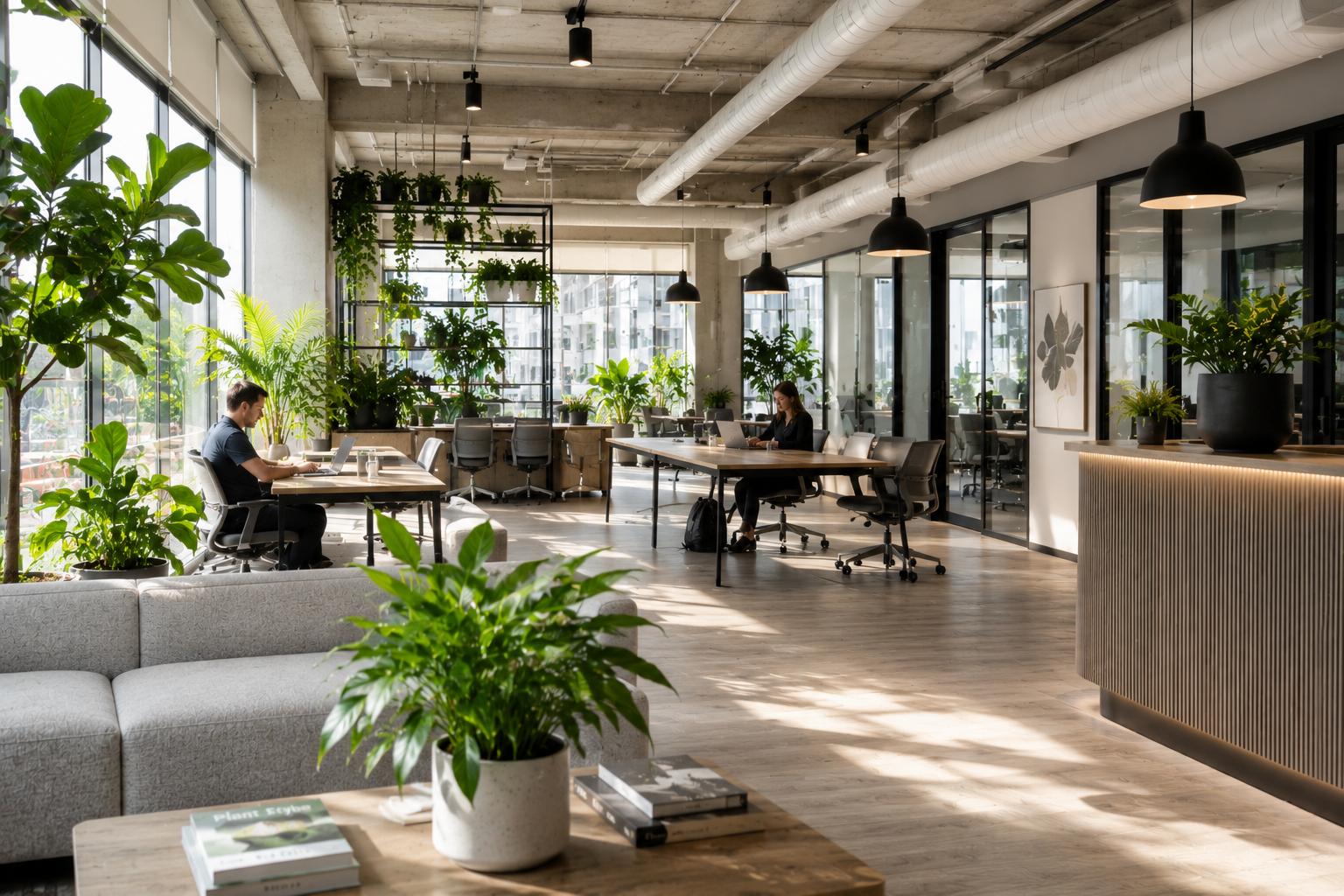
There’s a particular type of office that almost everyone recognises instantly.
Grey carpet. White walls. A few desks. Harsh lighting. Maybe one sad plant fighting for survival near reception because someone felt the room “needed a bit of life”.
Technically, there’s nothing wrong with these spaces. People can work there. Meetings happen. Emails get sent.
But they rarely feel good to be in.
And increasingly, that matters.
As hybrid work changes what people expect from workplaces, offices are no longer just functional containers for laptops and calls. The best spaces now do something more subtle: they make people feel comfortable, calm, energised, inspired; sometimes without even realising why.
This is where greenery and biophilic design start becoming less of a trend and more of a quiet competitive advantage.
And this is a lot less about being trendy, like offices suddenly needing to become a jungle café in Shoreditch, but because humans generally respond well to spaces that feel alive.
So why do some offices instantly feel better than others?
Usually because they feel designed around human experience rather than pure efficiency.
Many corporate spaces are built almost entirely from hard, uniform materials:
glass
metal
white walls
straight lines
artificial lighting
repetitive desk layouts
The result can feel visually flat and emotionally draining, even if the office itself is objectively “nice”.
Plants interrupt that pattern.
They soften edges. Add movement. Introduce variation. Break up sterile sightlines. Even small touches of greenery can change how people emotionally interpret a room.
This is one reason coworking spaces, hospitality venues and creative studios often lean heavily into plants. They help spaces feel less transactional and more human.
Interestingly, people often describe these environments using emotional language rather than design language:
“warmer”
“calmer”
“more creative”
“more welcoming”
“more premium”
“less stressful”
That shift in feeling is usually the real goal.
Can plants genuinely change the atmosphere of a workspace?
In our experience, yes. Often far more than clients initially expect.
We are not claiming plants magically solve workplace culture, but environments are quietly shaping behaviour and perception all the time.
A reception area with thoughtful greenery immediately feels ‘familiar’, more considered and cared for.
A breakout area with layered planting feels more relaxed and social than a row of empty chairs against a blank wall.
A meeting room with natural textures and greenery often feels less confrontational and rigid than a purely functional glass box.
People may not consciously walk into a room and think:
“Ah yes, excellent spatial biophilic integration.”
They just feel something different. After all, we may live in carefully manufactured cities today but our bodies are wired to feel at home in nature.
And that feeling affects:
first impressions
client perception
staff mood
perceived creativity
comfort levels
even how long people want to spend in a space
In hospitality and coworking environments especially, greenery often becomes part of the identity of the business itself.
What if our office doesn’t get much natural light?
Honestly, this is one of the most common concerns we hear, particularly in London.
A lot of offices have:
deep floorplans
internal meeting rooms
shaded ground floors
north-facing windows
or lighting that was clearly designed by someone who has never tried keeping a plant alive
The good news is that many commercial plants are surprisingly adaptable when chosen properly.
The important thing is avoiding the classic mistake of selecting plants purely because they looked good on Pinterest or in a hotel lobby somewhere in Malaga.
A plant that thrives in a bright atrium may struggle terribly in a darker workspace.
Good plant design is usually less about chasing trends and more about understanding:
light levels
airflow
heating patterns
maintenance realities
how people actually move through the space
In many cases, a smaller number of carefully chosen plants will outperform a much larger installation that isn’t suited to the environment.
That said, you may be surprised how some tropical shade varieties can thrive in a stable indoor environment here in the UK, with the aid of special lights or just limited sunlight.
We love the idea… but we don’t want another thing to manage
Completely fair.
Most offices already have enough operational chaos without assigning someone the unofficial role of “Head of Keeping the Fern Alive”.
This is why ongoing maintenance tends to make such a difference.
A proper maintenance service isn’t just occasional watering. It usually involves:
monitoring plant health over time
adjusting care seasonally
trimming and cleaning
replacing struggling plants where needed
checking drainage and watering routines
repositioning plants as spaces evolve
spotting issues before things quietly deteriorate into Plant Graveyard Corner™
The goal is for greenery to feel integrated into the environment rather than becoming another neglected office responsibility.
Ironically, the best-maintained plant spaces are often the ones people barely think about because everything simply feels good naturally.
Where do plants usually make the biggest impact?
Interestingly, not always where people first assume.
Filling every available corner with greenery can sometimes make a space feel cluttered rather than calming.
Strategic placement is usually far more effective.
Entrances and reception areas tend to have a huge impact because they shape immediate first impressions.
Breakout spaces benefit from greenery because plants help soften the transition away from “work mode” and encourage more relaxed interaction.
Meeting rooms often become noticeably less harsh with even subtle planting.
And awkward architectural areas like empty corners, harsh lines, dead visual zones, can often be transformed with surprisingly simple arrangements.
Sometimes the most effective installations are not the largest or most dramatic ones. They’re simply the ones that make a space feel more balanced and alive.
So what actually makes a workspace feel more human?
Usually, it’s not one big thing.
It’s the accumulation of small signals that tell people:
this place was designed thoughtfully
people are meant to feel good here
someone cares about the environment
this isn’t just a machine for productivity
Plants are powerful because they communicate many of those signals at once.
Not in a loud, overly branded or rational way.
Just quietly and intuitively.
And often, that’s exactly what a space needs.